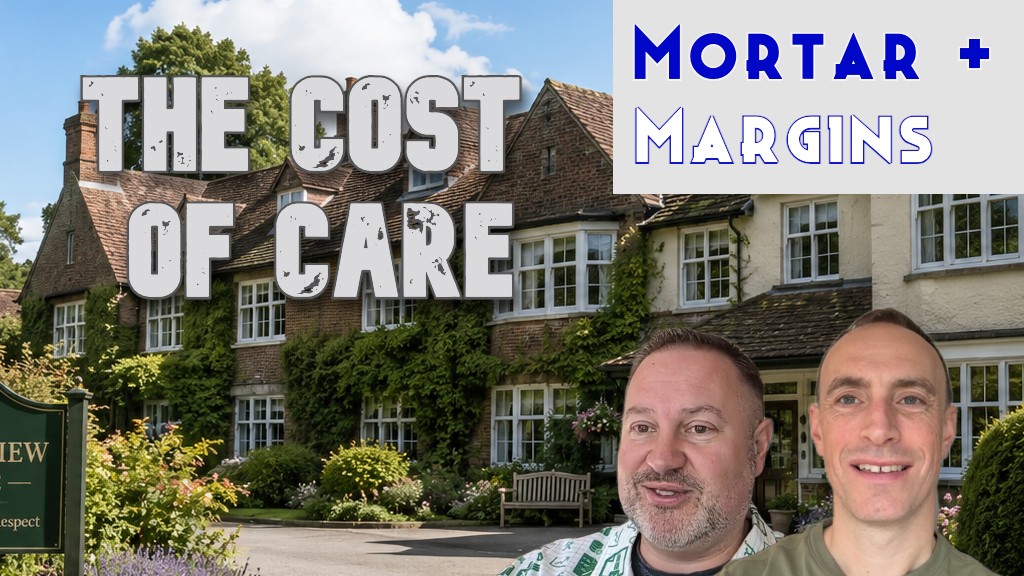
Mortar and Margins episode 21
Britain’s social care system is facing a demographic and financial crisis that few politicians appear willing to confront honestly. Demand for elderly residential care is rising rapidly as the population ages, yet the number of care homes is shrinking, smaller operators are disappearing and the economics of the sector are becoming increasingly unsustainable.
The contradiction is striking. In most industries, rising demand attracts new supply and investment. In elderly care, the opposite is happening. Hundreds of homes are closing while larger institutional operators increasingly dominate the market.
Size matters
The shift is being driven by economics. Investors and large care groups overwhelmingly favour bigger homes with 80 beds or more because they benefit from economies of scale. Smaller, community-focused homes often struggle to survive financially, particularly when a significant proportion of residents are funded by local authorities paying heavily constrained fees.
This has transformed the shape of the sector. Many of the intimate, family-style care homes that older people themselves might prefer are gradually disappearing, replaced by larger, more corporate facilities designed to appeal not necessarily to residents, but to their adult children who are often making the purchasing decision.
That distinction fundamentally shapes how the market operates. Unlike most industries, the end user is frequently not the customer making the choice. Sons and daughters, often themselves in their sixties, are selecting care environments for parents whose priorities may be very different. As a result, facilities such as cinemas, spas and luxury communal areas can become powerful marketing tools, even if residents rarely use them.
Behind the glossy brochures, however, lies an uncomfortable financial reality. The care system in Britain is technically delivered by private operators but heavily dependent on public funding. In practice, though, local authority contributions often cover only a fraction of the true cost of care.
The gap between publicly funded and privately funded residents can be enormous. In some parts of the country, private residents may pay nearly double the amount local authorities contribute for comparable care. Effectively, self-funding residents are subsidising the wider system.
This creates a two-tier structure where operators rely on attracting wealthier residents to remain viable. Homes catering primarily for local authority placements often struggle financially, particularly smaller homes that cannot benefit from the efficiencies available to large institutional providers.
The result is a market where quality varies dramatically. Official inspection ratings do not always tell the full story. While an “Outstanding” rating from the Care Quality Commission is a genuine achievement attained by only a tiny proportion of homes, the much broader “Good” category can encompass a huge range of standards.
How to choose
For families making decisions, this means inspections alone are not enough. The quality of care, staff interaction, activities and community atmosphere are often far more revealing than polished marketing materials or modern interiors.
Care itself remains the central issue. Families are not simply buying accommodation. They are trying to ensure dignity, safety and quality of life for loved ones at one of the most vulnerable stages of life. The emotional burden of those decisions can be immense.
Yet care homes are not always the bleak environments many people fear. For some residents, moving into care can actually restore social interaction, routine and community that had been lost through isolation or declining mobility. Activities, companionship and structured support can provide a significant improvement in quality of life when managed well.
The operational demands behind the scenes, however, are enormous. Running a care home bears far more resemblance to operating a hotel than managing a standard property portfolio. Staffing levels, healthcare needs, meals, compliance and safeguarding create constant operational pressure.
Care & property
At the same time, care homes remain heavily exposed to property and infrastructure costs. Energy efficiency, maintenance and building quality all directly affect profitability. Operators increasingly look at solar panels, heat pumps and modernisation projects not simply as environmental measures but as essential financial strategies in a sector operating on tight margins.
Despite all this, the economics of social care remain politically neglected. Governments repeatedly promise reform, yet long-term structural change never arrives.
One of the deepest problems lies in the gap between residential care and domiciliary care. Politicians often emphasise helping people remain in their own homes for as long as possible, largely because it is significantly cheaper than residential care. But home care services themselves are often stretched to breaking point, with carers working under intense time pressure and strict scheduling systems that leave little room for meaningful human interaction.
The demographic pressures are only intensifying. Britain’s population aged over 85 is projected to rise dramatically over the coming decade, creating soaring demand for care places while many smaller providers continue to exit the market.
Ultimately, the care sector exposes a broader societal contradiction. Britain depends heavily on private operators to deliver elderly care, yet simultaneously constrains the funding available to them. The result is a fragile system increasingly reliant on wealthy self-funding residents to sustain standards for everyone else.
For families, the challenge is deeply personal. For operators, it is an increasingly difficult business environment. For government, it remains one of the largest unresolved policy problems in modern Britain.
And for society as a whole, it raises an uncomfortable question about national priorities. A country that struggles to fund dignity and care for its ageing population while demand continues to surge may eventually be forced into far more difficult conversations than politicians currently seem willing to have.